<?xml version="1.0" encoding="UTF-8"?>
<!--Generated by Squarespace Site Server v5.9.2 (http://www.squarespace.com/) on Thu, 11 Mar 2010 03:48:22 GMT--><rdf:RDF xmlns:rdf="http://www.w3.org/1999/02/22-rdf-syntax-ns#" xmlns:rss="http://purl.org/rss/1.0/" xmlns:dc="http://purl.org/dc/elements/1.1/" xmlns:sy="http://purl.org/rss/1.0/modules/syndication/" xmlns:admin="http://webns.net/mvcb/" xmlns:content="http://purl.org/rss/1.0/modules/content/" xmlns:cc="http://web.resource.org/cc/"><rss:channel rdf:about="http://www.speakingpicture.com/journal/"><rss:title>The Waste Book</rss:title><rss:link>http://www.speakingpicture.com/journal/</rss:link><rss:description></rss:description><dc:language>en-US</dc:language><dc:date>2010-03-11T03:48:22Z</dc:date><admin:generatorAgent rdf:resource="http://www.squarespace.com/">Squarespace Site Server v5.9.2 (http://www.squarespace.com/)</admin:generatorAgent><rss:items><rdf:Seq><rdf:li rdf:resource="http://www.speakingpicture.com/journal/2010/2/12/winterreise.html"/><rdf:li rdf:resource="http://www.speakingpicture.com/journal/2009/6/4/that-joke-isnt-funny-anymore.html"/><rdf:li rdf:resource="http://www.speakingpicture.com/journal/2009/4/18/through-a-mask.html"/><rdf:li rdf:resource="http://www.speakingpicture.com/journal/2009/2/13/out-of-the-gate.html"/><rdf:li rdf:resource="http://www.speakingpicture.com/journal/2009/1/7/or-what-you-will.html"/><rdf:li rdf:resource="http://www.speakingpicture.com/journal/2008/12/13/alas-to-the-infinite-power.html"/><rdf:li rdf:resource="http://www.speakingpicture.com/journal/2008/11/23/spellbound.html"/><rdf:li rdf:resource="http://www.speakingpicture.com/journal/2008/11/14/in-the-clearing-stands-a-boxer.html"/><rdf:li rdf:resource="http://www.speakingpicture.com/journal/2008/11/10/the-better-angels-catch-a-break.html"/><rdf:li rdf:resource="http://www.speakingpicture.com/journal/2008/10/26/where-the-streets-have-too-many-names.html"/></rdf:Seq></rss:items></rss:channel><rss:item rdf:about="http://www.speakingpicture.com/journal/2010/2/12/winterreise.html"><rss:title>WINTERREISE</rss:title><rss:link>http://www.speakingpicture.com/journal/2010/2/12/winterreise.html</rss:link><dc:creator>Speaking Picture</dc:creator><dc:date>2010-02-12T20:45:40Z</dc:date><dc:subject></dc:subject><content:encoded><![CDATA[<p><span class="full-image-block ssNonEditable"><span><img src="http://www.speakingpicture.com/storage/bell tower.jpg?__SQUARESPACE_CACHEVERSION=1266007591244" alt="" /></span></span></p>
<p>&nbsp;</p>
<p>As much as he had enjoyed the notion spending the whole day inside, Cross knew by that afternoon that he couldn&rsquo;t let the snowstorm pass without going out into it. The next day would dawn beautifully, a world of white gleaming in sunlight, and then would almost instantly turn into an urban gray slush that clutched at ankles like the icy grip of the damned.&nbsp; Besides, now that he was ensconced in semi-suburban Riverdale, the snowy city would be lovelier than usual, so out he went.&nbsp;</p>
<p>Walking down the path, Cross nearly ran smack into a pine bough that usually wasn&rsquo;t there; it dipped down under the snow&rsquo;s weight, a curtain of dark green and white that he ducked under with the momentary sensation of one of the winter forests of his childhood. More than a foot of snow had fallen, and was still coming down in big wet flakes, their celebrated individuality obliterated the moment they came into contact with the world. Cross trudged up to the parkway, toward the lattice of frosted branches, white on black, that covered the horizon, broken here and there by one of the 1950s era apartment towers that seemed so incongruous amidst the small houses and large stone mansions that dotted the neighborhood.&nbsp;</p>
<p>Cross was still slightly stunned that Brooklyn had given way so easily to the Bronx, but more and more he gave himself over to flux, change itself the only change anyone could believe in. Even as the future assumed a pleasing shape (much like the Devil, who also lurked, per the clich&eacute;, in all the details of that future), Cross felt content to live day by day. He was, after all, taking at least one day back for every day that he had lost over the course of twenty months.</p>
<p>(He had almost thought <em>stolen</em> before mentally crossing it out and thinking <em>lost</em>, for he had been complicit in those days, those moments, all trailing behind like a wake now). By May he would have all of them back.</p>
<p>He stopped and stepped aside, out of his thoughts and into the snowbank, to let a woman on skies pass; she was smiling, out of breath. Beyond her a man pushed a snowplow, and another appeared suddenly with a shovel over his shoulder. Cross silently thanked them for making his walk possible; his snow boots had been one of the casualties of the move back uptown. As the woman passed, her legs and arms scissoring, Cross remembered Winter Camp, and his utter inability to cross-country ski. His skiing was so maladroit that soon he was far, far behind the rest of the campers. He vividly remembered looking up from his shuffling, scuffling labors and being alone on the trail, and feeling simultaneously frustrated with his complete lack of athletic ability and secretly pleased at the solitude it suddenly afforded, his snowsuit suddenly as bulky as an spacesuit, the winter white flecked with black like a negative of the starry void.&nbsp;</p>
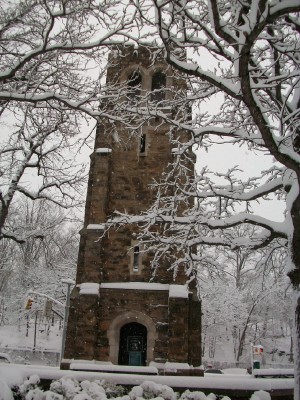
<p>It was cold. Cross walked down to the Bell Tower, crossing over the Parkway and making his way down Riverdale Drive. He thought for a moment of walking to Ewan Park and watching what would doubtless be a whole fleet of sleds careening down the park&rsquo;s steep slope, but knew he would only get as far as Salvatore&rsquo;s and a cup of hot chocolate.&nbsp;</p>
<p>In the drifting snow, the Bell Tower, its sides inscribed with the names of war dead forgotten along with those who mourned them, stood like a lovely old ruin of some kind. It stood on a traffic island and spent its hours, day and night, as a sort of stark Maypole for traffic; Cross&rsquo; bus swung by it daily. It was a landmark, but the sort of landmark that everyone used for navigation. Cross doubted many every really saw it, except at the holidays when a forlorn Christmas tree and neon menorah stood at the foot of it. It put Cross in mind of the Beaumont Tower on the campus of Michigan State.&nbsp;</p>
<p>Cross stood still for a moment, letting the snow alight. So much of winter was tied up in childhood now&mdash;snow, he had come to realize, represented the lost world of his childhood and his parents, and beyond that his grandparents, great-grandparents, people for whom the Mojave Desert would have been as exotic as the Sahara. It represented not only Michigan but New York, the upstate world of Syracuse and Port Byron where distant relatives perhaps still lived. And enough snow to cover them all, thought Cross to himself.</p>
<p>Outside of Salvatore&rsquo;s, a young boy, bundled but not too bundled, was methodically packing a snowball in his fists; Cross felt his own palms tingle at the memory of doing the same, and he remembered, too, Bill Cosby&rsquo;s snowball routine on <em>Revenge</em>, an album that Cross had listened to on many a snow day as a child, to the point where he could likely still recite the whole routine himself. As Cross made his way across Riverdale Avenue, he half hoped his hat would provide a target, but the boy, having shaped the snowball to his apparent satisfaction, suddenly let it crumble, dropping it to the salted sidewalk. <em>And my mother had thrown the snowball away&hellip;&nbsp;</em></p>
<p>Cross&rsquo; father had been one of the counselors that year at Winter Camp. Each counselor was assigned a half dozen campers and a cabin, and the fact that Cross had escaped being assigned to his father&rsquo;s cabin was almost proof of a higher power. Later, he discovered that all the boys in his father&rsquo;s cabin thought his dad was great: he had led them on a raid of the cafeteria after hours to steal extra rice crispy treats, and told them endless ghost stories after lights out. Cross had great difficulty reconciling this fun character with his irritable and irritated father and wondered if not getting assigned to that cabin had been such a blessing after all.&nbsp;</p>
<p>As Cross settled into the warmth of Salvatore&rsquo;s, the red-checked tablecloths somehow adding to that warmth, he also remembered his father putting him on a child&rsquo;s snowmobile (it seems they had such things in 1970s Michigan) at the age of six, and how it had shot off across an icy parking lot the moment the ignition had been turned. He remembered his father laughing as he cried, and why not? No harm done. But after that he had ridden solely on the back when his parents had taken their snowmobiles out, their roar cutting though those winter landscapes, turning them into extraordinarily loud silent movies. He remembered, too, walking out on the ice on Blue Lake, and his foot going through an iced over ice fishing hole, his leg plunging into the chilled black water all the way up to his thigh, and his father&rsquo;s arms under his own, pulling him out. What if the ice around that hole had suddenly cracked, Cross thought, looking out the window as the snowplow came by, pushing all this winter wonderland ahead of it like so much trash.</p>
<p>It occurred to Cross that living in seasons again, these last few years, had strangely heightened that feeling of living in the moment: the season had become the place to locate that moment in. Summer moments, winter moments, autumn moments. The years in the desert now felt weirdly outside of time, though the subtle seasons there, too, affixed the days. Cross knew it was raining in Vegas even as the snow was falling over New York, and he knew the smell of the desert after it rained, that pleasurable mixture of sage and mustiness, held fast any number of memories. He suddenly saw his father&rsquo;s face as he stood in the driveway of the ranch, the setting sun making him squint.&nbsp;</p>
<p>Cross saw, too, that those memories were crowded with many faces. Winter, however, and winter dreams, were solitudes, even when others were there&mdash;amidst the snow, you felt as if you were the only person in the world. It focused the mind somehow, the snowy landscape, and not because of that trope about how the freshly fallen snow was so clean, how it had somehow cleansed the world&mdash;the dirty old world was right there underneath it, waiting for the sun&mdash;but because it had transformed the world into an intimation of silence. Even the shovelers and snowblowers and snowplows perhaps sensed this, and their resentment at having to clear the world had less to do with toil and more to do with a fear of that silence. And it wasn&rsquo;t that such silence was some intimation of death, of oblivion (though it could be, and perhaps was feared to be) but of eternity: the silence of being outside of time, of perpetual waiting for something that had already happened.&nbsp;</p>
<p>Which actually, come to think of it, was a pretty good definition of death. Life, however, was hot chocolate. Cross took a sip, and then another, sitting alone at a table by the window, watching the snow drift down as the sky darkened.</p>
<p>&nbsp;</p>]]></content:encoded></rss:item><rss:item rdf:about="http://www.speakingpicture.com/journal/2009/6/4/that-joke-isnt-funny-anymore.html"><rss:title>THAT JOKE ISN'T FUNNY ANYMORE</rss:title><rss:link>http://www.speakingpicture.com/journal/2009/6/4/that-joke-isnt-funny-anymore.html</rss:link><dc:creator>Speaking Picture</dc:creator><dc:date>2009-06-04T04:33:46Z</dc:date><dc:subject></dc:subject><content:encoded><![CDATA[<p>&nbsp;</p>
<p><span class="full-image-block ssNonEditable"><span><img style="width: 400px;" src="http://www.speakingpicture.com/storage/imperial.jpg?__SQUARESPACE_CACHEVERSION=1244090192381" alt="" /></span></span></p>
<p>&mdash;I fear that old line about Vegas has finally seeped into this event, said Jack as he popped another piece of Nicorette gum in his mouth.</p>
<p>&mdash;What&rsquo;s that? asked Ray as he watched a desultory parade of what passed for hipsters wend its way past them.</p>
<p>&mdash;Las Vegas is the only place where you can have a good time without actually enjoying yourself, said Jack. He smiled without mirth, his eyes doubtless rimmed in red behind his smoky-dark prescription sunglasses.</p>
<p>&mdash;Attributed to Jack Carter, I believe, said Ray.</p>
<p>&shy;&mdash;Well, it&rsquo;s Jack Samson&rsquo;s now, replied Jack with a smack.</p>
<p>They were standing on the corner, just down the block from the Sugar Shack antique store. The sun was going down, and the light glinted off Jack&rsquo;s glasses while Ray shielded his eyes and looked up the street. It was the monthly gallery crawl, which more or less functioned as the monthly see and be seen, drink free wine while ignoring the art, wander in and out of the bars, get drunk by the time the bands go on, wake with a hangover crawl as well. Vendors had set up booths of various kinds up and down the streets, but the scattered clots of crawlers didn&rsquo;t stop at most of them long enough to register whatever (beaded purses, scrap-metal sculptures, self-published thrillers) was for sale. In other words, not much had changed since the last time Ray had been in town, except for new names on the galleries, new studios in place of those who&rsquo;d given up the art ghost and moved on, new bands reconfigured from old ones, now playing in the same dozen bars (only the DJs seemed eternal).</p>
<p>Still, Ray felt obliged to check in whenever he was here, if for no other reason than to say hello to old friends (well, old acquaintances, mostly). Jack, who by now had nothing but scorn for the &lsquo;farts district,&rsquo; would only indulge him for so long before pulling him away for drinks at the Chimera (the only bar downtown that steadfastly refused both video poker and live music, thus endearing it to Jack, who reviewed concerts for a living and didn&rsquo;t need, as he put it, to watch shitheads stumble around four chords on his nights off). Then again, Jack still lived here. Ray was just a visitor these days.</p>
<p>&mdash;Can you believe somebody put hours and hours of their time into that?</p>
<p>Ray knew it was a rhetorical question, but he turned to look anyway and followed Jack&rsquo;s gaze through the windows of a little storefront gallery where huge abstract canvases slathered in paint simultaneously drew the eye in and spit it out. Jack shook his head.</p>
<p>&mdash;At least a mediocre guitar player in a bar band might get laid for his troubles, said Jack.</p>
<p>&mdash;You&rsquo;d be surprised how easily painters get laid, said Ray.</p>
<p>&mdash;That&rsquo;s only because you used to sleep with one.</p>
<p>&mdash;True, said Ray. But it wasn&rsquo;t exactly easy.</p>
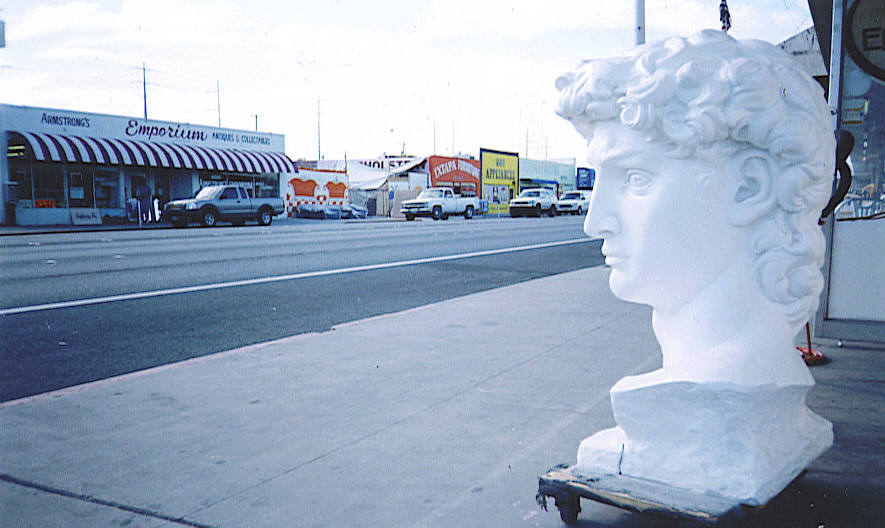
<p>Jack looked up the avenue, where the galleries were mixed with Mexican furniture stores; a giant, plaster head of David sat out on the sidewalk, glancing back at Ray and Jack with a what looked like a look of desperate, befuddled hope and dawning resignation.</p>
<p>&mdash;Is that replica of David still inside Caesars? asked Ray.</p>
<p>&mdash;Christ, who knows. I haven&rsquo;t been inside that part of Caesars in years. I wouldn&rsquo;t even have been in the Forum addition yet if I hadn&rsquo;t been lingerie shopping for Delia.</p>
<p>&mdash;One more round, Delia&rsquo;s gone, one more round, sang Ray in a low voice.</p>
<p>&mdash;She&rsquo;ll be back, said Jack with a shrug. And wearing the lingerie, too.</p>
<p>Ray very much doubted that Delia would be back, but if she did reappear in Jack&rsquo;s life it was likely to be without a dime and on the run from somebody; she likely wouldn&rsquo;t have anything left but the fancy lingerie. But that was Jack&rsquo;s way of keeping himself intact&mdash;he dated crazy and used crazy as an excuse not to get too close. That much hadn&rsquo;t changed.</p>
<p>&mdash;Listen, said Ray, we should just go over to the Bomb and see what Nadia has up on the walls and then we can go hit the Chimera.</p>
<p>&mdash;Ah, said Jack with a smile, I forgot to tell you: the Bomb is gone.</p>
<p>&mdash;What? Really? How is that possible? When did it close?</p>
<p>&mdash;Oh, it didn&rsquo;t close&mdash;just moved. Nadia moved it to LA. Said the market had gone from soft to melted here. Jack jerked his thumb at a crowd of teenagers making noise in front of one of the booths. Can you blame her? Look at who shows up now&mdash;the same, tired, hundred art mavens and a ton of broke-ass kids who just want to have something to do.</p>
<p>&shy;&mdash;Well, sure, said Ray. If this had existed when we were in high school, we would have been hanging out here. But Jack wasn&rsquo;t listening; he&rsquo;d launched into an air guitar version of &ldquo;I Just Want to Have Something to Do,&rdquo; his arms slung low like Dee Dee Ramone as he fingered imaginary bass frets.</p>
<p>&mdash;Toooo night... to-oo-night... well, all riiiiiiiiiiiiight....</p>
<p>&mdash;Hey, Ray! called a voice. In the setting sun, a t-shirted mass approached. Ray looked up into the bug eyes of The Mann. Inevitably, he saw The Mann whenever he was in town; inevitably, the conversation went like this:</p>
<p>&shy;&mdash;How&rsquo;s tricks, Ray?</p>
<p>&mdash;Well, you know, I gotta get a bigger hat.</p>
<p>&shy;&mdash;Hah! Again? But that trick never works! Hah!</p>
<p>&shy;&shy;&mdash;That joke isn&rsquo;t funny anymore, sang Jack under his breath.</p>
<p>&shy;&mdash;You still with the station, Mann?</p>
<p>&shy;&mdash;You know it, somebody has to teach the children about rock n&rsquo; roll. Hey, I want you to meet someone. Someone stepped out of the bulk that was Nicholas Mann; a tiny woman about their age, with a black pixie cut and trendy glasses.</p>
<p>&mdash;This is Angelica, my girl, said Mann. You won&rsquo;t believe this, but she went to Western same time as me, and we didn&rsquo;t know each other at all&mdash;not at all! And then we met here!</p>
<p>&mdash;Here? said Jack. On the corner? I thought the girls worked farther east.</p>
<p>&mdash;Hah hah! Hey, this is Ray Sands, the magician.</p>
<p>Angelica gave out a little squeal. &mdash;I used to take my kids to that afternoon show you had, years and years ago!</p>
<p>Ray smiled and assumed the face he was long used to assuming, but Jack gave a short little laugh. &mdash;That was almost twenty years ago. Pop out a couple with your high school sweetheart, did you?</p>
<p>&mdash;Hah! Angie, this is Jack Samson.</p>
<p>&mdash;No way! Of Samson&rsquo;s Army?</p>
<p>Jack winced a little. &mdash;No, no. Different Samson. Completely different Samson.</p>
<p>&mdash;I loved Samson&rsquo;s Army! burbled Angelica. I&rsquo;m older than I look, hah?</p>
<p>&mdash;You look perfect to me! said Mann, giving her a squeeze. Jack used to be a DJ with me, back in the day.</p>
<p>&mdash;I was never &lsquo;with&rsquo; you, Mann, said Jack. I only orbited you. Whenever I got to the far side, I played a few records before gravity shot me back around.</p>
<p>Mann laughed in the way of someone so used to being big it barely registers. But Ray remembered Mann at nineteen, crying over an empty bottle of vodka at a party, his thick legs somehow stuffed through the bars of an apartment balcony, after a good half-hour of jokes at his expense. Mann didn&rsquo;t lose his virginity until years later, when his impeccable geek credentials at long last outweighed his literal weight during the improbable rise of geek chic in the 1990s. Mann found his groove and had worked it, Ray thought to himself, into a nice, deep, comfortable trench from which he could laugh off anything.</p>
<p>&shy;&mdash;Hey, you guys should come to the show, said Mann, completing the encounter in the only way an encounter with him could end, with a flier in your hand. These guys are from Portland, and they&rsquo;re really awesome, like Yo La Tengo meets Animal Collective.</p>
<p>&mdash;Sorry, Mann, said Jack, but we&rsquo;re going to have a really awesome evening where bourbon meets my tongue.</p>
<p>They exchanged good-byes, nice to meet you&rsquo;s, nothing up my sleeve, prestos. As they disappeared into the milling crowd, Jack cackled.</p>
<p>&mdash;There goes a Mann, he said. How does he manage to push forty and still be like that?</p>
<p>&shy;&mdash;He&rsquo;s happy, said Ray, simply, staring after Mann&rsquo;s bulk, his girlfriend like a toy poodle under his arm. Jack snorted.</p>
<p>&mdash;Everything changes, nothing changes. Two steps forward, five steps back. All these artsy bars and attempts at galleries, and the Shangri-La Telegraph Office is still an empty lot, a bulldozed fucking lot. And Mann&rsquo;s happy as a big, loud, clueless clam.</p>
<p>Ray smiled without looking at Jack. &mdash;And you&rsquo;re still here, he said.</p>
<p>Jack didn&rsquo;t look at him either. &mdash;And you still keep coming back, even though you&rsquo;ll never work this town again.</p>
<p>&mdash;Well, said Ray, as he turned and began walking down the sidewalk, toward David&rsquo;s empty, bewildered eyes (bewildered at their emptiness? Or empty because bewildered?) You can only disappear so many times.</p>
<p>&shy;&mdash;Or just the once, said Jack, spitting out his gum.</p>
<p>&nbsp;</p>]]></content:encoded></rss:item><rss:item rdf:about="http://www.speakingpicture.com/journal/2009/4/18/through-a-mask.html"><rss:title>THROUGH A MASK</rss:title><rss:link>http://www.speakingpicture.com/journal/2009/4/18/through-a-mask.html</rss:link><dc:creator>Speaking Picture</dc:creator><dc:date>2009-04-18T23:44:37Z</dc:date><dc:subject></dc:subject><content:encoded><![CDATA[<p>&nbsp;</p>
<p><span class="full-image-block ssNonEditable"><span><img style="width: 300px;" src="http://www.speakingpicture.com/storage/vendetta.jpg?__SQUARESPACE_CACHEVERSION=1240100046823" alt="" /></span></span></p>
<p>Cross wondered, often, if his heart was black because it was charred or black because the poison had done its slow, relentless work. He didn't like to think it was only black from all the ink, but in the moments of honesty that piled up, week to week, like newspapers on the porch of a haunted house, he had to admit the possibility.</p>
<p>Why was he so reluctant, so resistant? Because that would mean it was all still a state of being mediated by words and nothing more, Cross replied to the mirror that refused to show him anything but his own reflection. Cross didn't want to feel literary (isn't that why nothing would come of late, no work, no matter how insistent its tapping at his--ah, can't resist--chamber door?). But Cross didn't want to feel literal, either: as if something really had been altered, fundamentally, and wasn't just a hostage to the time that healed all wounds... except the wound made by time itself.</p>
<p>Cross kicked himself now and then, like Dr. Johnson kicking that stone, and refuted his own sense of abstraction. He didn't want to only be alive in words, but he didn't want to be dead to them... Thinking of Johnson made him think of Beckett, of course. Language was indeed a veil, and he was tired of veils, tired of the perfect logic and reasonableness of veils, the Grand Unified Theory that was a veil upon a veil upon a veil...</p>
<p><em>One must speak through a mask, through a persona</em>. Was that Yeats? Cross could have looked it up, typing the words into the magic window that seemed to bring all of existence to him while simultaneously holding it at bay. Instead, Cross looked out again through the mundane window, the one that gathered darkening blue in the still bare branches of the tree outside, and the sounds of cars hissing by the reservoir that was now too black to admit any light. Language seems a poor revenge, thought Cross, but he'd had that thought before. Thousands had that thought before; hadn't done them a bit of good either.</p>
<p>Cross looked at the scattered thoughts in his notebook, trying to move forward while something within (surely not his heart, whatever it's real color) just as insistently held him back. <em>Seriousness is often mistaken for pretentiousness, the way you mistake the face of a distant figure for a mask when it is indeed their face, their only face</em>. Cross looked out the window again, and sat still for a while. He had only to switch on the light to see his own face, strange and comforting, peering back at him from the oncoming night.</p>]]></content:encoded></rss:item><rss:item rdf:about="http://www.speakingpicture.com/journal/2009/2/13/out-of-the-gate.html"><rss:title>OUT OF THE GATE</rss:title><rss:link>http://www.speakingpicture.com/journal/2009/2/13/out-of-the-gate.html</rss:link><dc:creator>Speaking Picture</dc:creator><dc:date>2009-02-13T20:32:14Z</dc:date><dc:subject></dc:subject><content:encoded><![CDATA[<p><span class="full-image-block ssNonEditable"><span><img style="width: 500px;" src="http://www.speakingpicture.com/storage/night%20mare.jpg?__SQUARESPACE_CACHEVERSION=1234557247985" alt="" /></span></span></p>
<p>Whenever Cross took the A train out to JFK, he couldn&rsquo;t help but look out the window at Aqueduct and think, I should come out here some time during the season. The thought had the character of something that would never be acted on, but it also had the urgency of something that sooner or later would happen. But why, Cross wondered. He hadn&rsquo;t been at a race track since the age of twelve. That&rsquo;s why, a voice answered back.</p>
<p>When Cross was around eight or so, his father bought several thoroughbreds. These horses existed at some remove from East Lansing, housed at tracks in the suburbs of Detroit, and maintained by a series of trainers who loomed in Cross&rsquo; imagination like archetypes of desperation and failure: Denny, in his John Deere cap, who radiated haplessness in his eyes and speech; Larry, dark-haired, tanned as his stylish leather coat, who seemed ready to hustle you even if all you were talking about was the weather; Butch, bullet-headed and bearded, who seemed to live for the moment when the day&rsquo;s work was done and the neck of a Southern Comfort bottle would widen to swallow him whole; Spider, with his cowboy hat and Kung-Fu mustache, his snowy white husky and his guitar, who seemed as kindly and gentle as a philosopher, right up to the day he loaded his pick-up with hundreds of dollars worth of tack and disappeared without so much as a note.</p>
<p>After this roll call of incompetence and drama, which unfolded alongside the expansion of the stable until over thirty thoroughbreds now patiently munched their hay awaiting their chance to come in fourth or fifth at Hazel Park or Detroit Race Course, Cross&rsquo; father decided that he was overdue for a mid-life crisis, and dispensed with the services of trainers altogether, along with his twenty years as a real estate broker. His father would become an owner/trainer, and make his living on the purses. Cross&rsquo; mother looked askance at this, naturally, but it was the price she paid to finally leave Michigan and its winters behind; six months after the decision, Cross looked up from his comics or Micronauts, spread out on a table in the club house, and saw the decrepitude that was Jefferson Downs, just outside of New Orleans.</p>
<p>The rest unfolded more or less according to the script for this sort of thing: near bankruptcy, separation, reconciliation, the move west, the return to real estate. But even by the time Cross was in high school, his father insisted on retaining horses, and bought a ranch house off of Las Vegas Boulevard South, in the days before housing developments swallowed up such ranches. For several more years, as his father tried to raise thoroughbreds that would never race (the desert not being conducive to breeding), Cross looked across the lawn into the eyes of a half-dozen doleful mares, each of them twitching their ears as if they could hear his mother&rsquo;s litany of complaints as the cost for what was now a ruinously expensive hobby mounted.</p>
<p>Eventually it did stop, as all things do. The horses were sold, and then the ranch. By then his father would no longer have recognized the fact that he had ever owned horses&mdash;he might not have been able to tell you what the word <em>horse </em>signified. For Cross, horse signified nothing so much as familial unhappiness and strife. For a long time. Cross cultivated a studied dislike of horses.</p>
<p>This hadn&rsquo;t been the case when he was a child. Though he was mostly ambivalent about them, there was a certain excitement when horses first appeared in his life. He&rsquo;d had his own horse, a tame Arabian that he would occasionally ride around the stables when he wasn&rsquo;t helping muck out stalls, a task that taught him how to breathe through his mouth for hours on end (there was nothing as sinus-opening as fresh horse piss, thought Cross). He was fascinated by the oddball names that thoroughbreds acquired, and often listed them in his mind or spoke them aloud like a chant: Royal Perfecto, Canadian Jeff, Wee-Ette, Hairbreadth Harry, Queen&rsquo;s Hand (a mean one, that last, always ready to bite if you walked to close to her stall). Cross remembered trying to sketch them&mdash;he was always drawing in those days, how he wished he hadn&rsquo;t stopped&mdash;remembered studying Wee-Ette for what seemed like hours...</p>
<p>Even during the races, Cross would set his fantasy world aside long enough to study the racing form. He remembered his mother patiently teaching him how to handicap, and the joy when the $2 bet his mother had put down on his recommendation came through... that was a chant, too: trifecta, perfecta, exatca... (How many times could that have happened? It seemed to Cross he&rsquo;d won more than once, but that couldn&rsquo;t be right, could it? Would he recall any of that if he looked at a racing form?) He remembered, too, those times in the winner&rsquo;s circle, the breathless run down from the club house, the smell of sweat, the jockey&rsquo;s grimy face above his silks, the quick arrangement of people and horse just before the photographer&rsquo;s flash... He wasn&rsquo;t there for it, but he remembered too when Hairbreadth Harry dropped dead of a heart attack after winning a race, the halter twisting in his father&rsquo;s hand, the jockey giving out a startled yelp as the animal sank suddenly to its knees... Cross always wished it had happened as the photographer released the shutter, so there would be proof to correspond to his mind&rsquo;s-eye memory.</p>
<p>Poor Harry. Cross always thought of that when he thought of his father&rsquo;s passion. But that was what most rankled Cross, what made him feel most ambivalent about these memories: was it his father&rsquo;s passion? It was something Cross had never been able to figure out: did his father really love horses? Of was it all of a piece with his father&rsquo;s persistent, pathetic ambition: to be a big shot? Didn&rsquo;t his father ultimately care more about being the sort of man who owned and raced thoroughbreds (and was known to do so), then he did about the horses themselves? Who cared more about purses and stud fees than a love for animals?</p>
<p>Cross wanted to give his father the benefit of the doubt. He pictured his father brushing one of them after a workout, remembered the way the horse&rsquo;s flesh would shudder and twitch a little, the way the horse&rsquo;s eyes would take on that sleepy, patient, satisfied look of a dreamer. Horses always seemed a little dreamy to Cross, and the rituals they would endure in order for a little feed and peace always gave him a twinge. Cross readily understood that deep connection, forged over centuries, between humans and horses&mdash;that strange intimacy born of mutual need and respect&mdash;even if he didn&rsquo;t feel the pull much. But wasn&rsquo;t the reason he didn&rsquo;t feel the pull was the image of his father&rsquo;s face: impatient, full of the concentration on the task at hand but little else. Surely his father felt some sort of connection. Surely the only time he smiled couldn&rsquo;t have been in the winner&rsquo;s circle.</p>
<p>Well, what if it was. They were all dead, his father and those horses, all run off over distant hills. The last time Cross had felt anything while in the presence of a horse was during a hike near Lake Mead, when they&rsquo;d come across three wild horses that didn&rsquo;t run off, but shadowed them as they walked, always keeping a hundred yards between Cross and his friends whenever they moved toward them. That was a little magical. But to spend a day at Aqueduct wouldn&rsquo;t be about horses, and it certainly wouldn&rsquo;t be about gambling&mdash;it would be an attempt to reconnect with an atmosphere that said <em>father</em> . You might as well crack open a bottle of Old Spice, reflected Cross, for a sense memory that at once meant so much and really meant nothing at all.</p>
<p>Besides, who among his friends could he convince to go to the track anyway? He certainly couldn&rsquo;t go alone... Cross turned away from the window and thought he could always present it as a lark: a retro, boozy, Runyonesque day at the races... His father would have been 75 yesterday, thought Cross as the train lurched and swayed. Cross was now the same age as his father had been when he heard the Call to Post, but Cross had long ago given up on being a big shot... What did it matter, the nature of his father&rsquo;s pleasure? What did it matter what horses had meant to his father? It had meant something, after all. When, Cross wondered, would he stop sitting in judgment of the dead?</p>
<p>Ah, but when does anyone stop sitting in judgment of the dead. What was paternity but the long, arduous fitting for robes of those who will ascend the bench in the court of memory and love?</p>
<p>Perhaps Cross would go the track alone after all, one day in the spring, if for nothing more than the pleasure of making a bet, and tearing up the losing ticket as the rumble of hoofs faded, and scattering its pieces to the wind with a deep and knowing sigh.</p>
<p>&nbsp;</p>]]></content:encoded></rss:item><rss:item rdf:about="http://www.speakingpicture.com/journal/2009/1/7/or-what-you-will.html"><rss:title>OR WHAT YOU WILL</rss:title><rss:link>http://www.speakingpicture.com/journal/2009/1/7/or-what-you-will.html</rss:link><dc:creator>Speaking Picture</dc:creator><dc:date>2009-01-07T03:50:23Z</dc:date><dc:subject></dc:subject><content:encoded><![CDATA[<p><span class="full-image-block ssNonEditable"><span><img style="width: 300px;" src="http://www.speakingpicture.com/storage/Bridge II.jpg?__SQUARESPACE_CACHEVERSION=1231300333478" alt="" /></span></span></p>
<p>Cross had crossed over. He wasn&rsquo;t sure what the Brooklyn initiation rite consisted of&mdash;a slice of overpriced cheesecake at Junior&rsquo;s? But he was content with the move. He was more content that he had crossed over from a year of sorrow and confusion to a year full of promise and... well, confusion, he supposed. Cross sought to maintain a sanguine attitude, but it was difficult, especially as the Great Recession seemed to deepen with every passing day, like white cotton infused with a dark, purpling dye.</p>
<p>But there will always be woe and worry of woe, thought Cross. The new year was a fresh page&mdash;or, to be current, a blank screen; a blank screen that wasn&rsquo;t an arbitrary division of seasons and revolutions around the sun. It was waiting, in the hum of light from his laptop, waiting to be inscribed with whatever light managed to slip through the cracks of his mundane concerns (though how to survive the spiraling downturn didn&rsquo;t seem so mundane to Cross). Cross also had the suspicion that precisely those concerns would soon eclipse what really mattered, and that he was going to have to fight for the light.</p>
<p>And here it was, Twelfth Night, the Feast of Epiphany (how Cross loved those words, even though he wouldn&rsquo;t have known the proper Christian rituals that went with them even if the epiphany itself had smacked his leaden brow), the new year nearly a week gone, and Cross was on some level exhausted. He felt exhausted by all he needed to do, all he planned to do, all he wanted. He might chalk it up to winter ennui, but he knew it was more than that, though how much more he didn&rsquo;t want to guess.</p>
<p>It was the enormity of the task&mdash;the enormity of analyzing, revisiting, investigating what had happened to him during his long spell in limbo. Thoughts of it consumed him, especially while he explored his new neighborhood&rsquo;s cold, trash-strewn streets&mdash;consumed him, that is, until he felt his chest tighten and he filed them away. Save it for when you&rsquo;re at your desk, he told himself. But at his desk he only stared numbly at his memories.</p>
<p>There were new and marvelous diversions, of course, and Cross was very grateful for them. But he wondered how and when he would get down to work before his paying work began and drained some of his energies. Perhaps he was being too hard on himself; after all, he thought, you don&rsquo;t fully recover on any timetable but Time&rsquo;s. But so much of it had already been lost...</p>
<p>When Cross was eight or so, he&rsquo;d gone away not to summer camp but to a winter camp, somewhere in Michigan. It was a collection of musty cabins in snowy clearing, high up in the hills. His father had volunteered to be one of the camp counselors, but Cross had dodged the bullet of being assigned to his father&rsquo;s cabin. There were hikes and winter sports, and a memorable afternoon spent in a dry lake called the Devil&rsquo;s Bowl, whose sides were smooth with packed snow, and no sled was needed to slide right to the bottom, dodging stray, straggly trees all the way down.</p>
<p>There was also a day allotted to cross-country skiing. Cross was unathletic, and hopelessly uncoordinated, but there was no way out of it. He strapped on the skis and grabbed hold of each pole as if they were levers to some invisible machine that needed constant stoking. But Cross&rsquo; movements were so ungainly that he moved like a long distance runner going all out at the bottom of a pool. Within minutes, he had fallen far behind the others; soon, he couldn&rsquo;t see them at all. Breathing hard, frustrated, Cross might as well have been Sisyphus, rolling his rock endlessly up the mountain&mdash;except that Cross himself, his body that was not trained to respond like this, that never failed to betray him in physical exertion, was the rock.</p>
<p>By the time he&rsquo;d reached the camp, the jokes were waiting: Cross can&rsquo;t cross, Cross can&rsquo;t cross. His anger at having to participate in something he cared nothing for and had no talent in was acute.</p>
<p>That&rsquo;s how Cross sometimes felt these days&mdash;not angry, no... But he felt as if his limbs were encased in a snowsuit, his feet strapped to devices that made it hard to move, his arms working grimly and futilely at trying to move himself forward, to steer himself through the white expanse of bare trees that was the winter of his mind.</p>
<p>A dear friend of his had recently asked him what was it he wished for, what was it he wanted... Cross was at a loss. His wish list ran to several heavy volumes, each without an index. As for what he wanted... well, he wanted what he always wanted: to step upon the stage and play the part that he had been born (and so long understudied) to play... whatever that part was. And he wanted to come to the last act and find Viola, her disguise cast aside. But no one ever sees the day to day of the happy marriages that Shakespeare contrives to resolve each comedy. Like an old-fashioned movie, there is always a fade-out after the kiss... Cross suspected that he needed to play his part, now that the pandemonium shadow show of his long limbo had closed, and just let the kisses and the fade-outs sort themselves out.</p>
<p>&nbsp;</p>
<p>&nbsp;</p>
<p>&nbsp;</p>]]></content:encoded></rss:item><rss:item rdf:about="http://www.speakingpicture.com/journal/2008/12/13/alas-to-the-infinite-power.html"><rss:title>ALAS TO THE INFINITE POWER</rss:title><rss:link>http://www.speakingpicture.com/journal/2008/12/13/alas-to-the-infinite-power.html</rss:link><dc:creator>Speaking Picture</dc:creator><dc:date>2008-12-13T00:27:52Z</dc:date><dc:subject></dc:subject><content:encoded><![CDATA[<p><span class="full-image-block ssNonEditable"><span><img style="width: 400px;" src="http://www.speakingpicture.com/storage/clocks.jpg?__SQUARESPACE_CACHEVERSION=1229128262001" alt="" /></span></span></p>
<p>Cross wanted to be one of those people who had no use for nostalgia, but he was more or less born nostalgic. It was somehow part of his genetic make-up, and thus he wasn&rsquo;t so disgusted with himself whenever he indulged. Besides, memory was so important to Cross&mdash;so utterly crucial to who he was, what he did, how he saw the world&mdash;that he always expected nostalgia&rsquo;s warm, syrupy glow to creep into the acts of remembrance that made up the texture of the present. He had long ago given in to nostalgia for a past that was vanishing before he was born; not a small step to give in, at least a little, to nostalgia for the past he moved through, helpless as a shark in deep blue waters.</p>
<p>Incipient middle-age didn&rsquo;t help. Lately, voices out of his past, voices twenty or fifteen years removed, had come to echo around the chambers of Cyberia. The World Wide Web was a perfect trap for the ephemera of the past, if anyone cared to throw it out there (and many did). The ability to digitize and post old photos now meant that everyone could sit on a vast virtual couch on a melancholy evening, perhaps a little tipsy, and turn the leaves of a rarely visited album, and hear the running commentary of their friends and comrades, as if everyone you&rsquo;d ever known was somehow home for the holiday and looking over your shoulder...</p>
<p>Not everyone. Many resisted the online life&mdash;they were the wise ones, and often Cross wished that back around 1995 or so he&rsquo;d made some different choices. But having crossed that Rubicon, giddy, thoughtless, amazed, Cross felt the virtual life was something to be managed now, not dispensed with entirely. He&rsquo;d briefly tried, and only felt like a hermit with the benefit of spiritual enlightenment. You&rsquo;d need to go off the grid completely, and that wasn&rsquo;t Cross anymore than the sort of person for whom only the future is real.</p>
<p>But more than the refuseniks, Cross now felt the pull of absent friends keenly. More so, now that they rose, just as luminous and unreal as any spectral presence, from Flickr accounts and Facebook albums. The dead came to you in your dreams&mdash;Cross often thought of the afterlife, of the idea of Heaven itself, as basically an explanation for dreams&mdash;but now they popped up in your inbox as well, part of daily routine. Even if you limited your time online to a sensible hour or so, they would come at you, daily.</p>
<p>Cross wasn&rsquo;t so disturbed by this. He was pleased to see that, while death had indeed undone so many (and only add to the legions as he and everyone ages), their images made them more present than ever, especially as they multiplied beyond whatever collection of photos Cross had and now came from every direction of acquaintance. He was simply, purely happy to see these absent friends, even if every memory was suffused with... well, with what? Not regret. Well, sometimes regret. Not pain, for a decade will do its work, leaving pain&rsquo;s memory where pain once glowered like a spreading bruise.</p>
<p>No, more like an Alas, that poetic anachronism now supplanted by Oh, Well or (if you weren&rsquo;t feeling warm or fuzzy) Whatever. Living with ghosts, even happily, even in dreams or reminisces, was an Alas to the infinite power, a thumbing of one&rsquo;s nose at eternity.</p>
<p>Which&mdash;alas&mdash;is the only thing you can do to eternity, mused Cross.</p>
<p>&nbsp;</p>]]></content:encoded></rss:item><rss:item rdf:about="http://www.speakingpicture.com/journal/2008/11/23/spellbound.html"><rss:title>SPELL/BOUND</rss:title><rss:link>http://www.speakingpicture.com/journal/2008/11/23/spellbound.html</rss:link><dc:creator>Speaking Picture</dc:creator><dc:date>2008-11-23T21:14:55Z</dc:date><dc:subject></dc:subject><content:encoded><![CDATA[<p><span class="full-image-block ssNonEditable"><span><img src="http://www.speakingpicture.com/storage/beuque04.jpg?__SQUARESPACE_CACHEVERSION=1227474931673" alt="" /></span></span></p>
<p>&nbsp;</p>
<p><strong>I. Daphne</strong><br /><br />Red hair, green headband, purple sweater and mini-skirt, lavender stockings. Except these details have been drained of their signifying colors, the perpetual chromatic pattern that denotes her character in countless cels, countless hours of Saturday morning cartoon dreck. Drained, because she&rsquo;s a drawing in a coloring book now, ready to be filled in with Crayolas, with whatever colors his six-year-old hand deems appropriate. But he never gets around to that, because other details, new details, have overwhelmed his eyes. For in this drawing (as in nearly every episode of <em>Scooby-Doo</em>), Daphne is bound and gagged: ropes empty of color encircle her ankles and pin her hands unseen behind her, while a blank expanse of white obliterates the lower half of her face, beneath those doe eyes. She doesn&rsquo;t look scared or helpless, exactly: she is the designated Damsel in Distress (poor scholarly Velma never gets to have any kinky fun). Her eyes, drawn by an anonymous hand and reproduced by the thousands, seem to say <em>this is what I was made for</em>. Or is that his inarticulate gaze, projecting something he does not and will not ever understand, something at the core of his being: <em>this is what I was made for</em>. His cock hardens, long before the concepts of puberty or sex are even a full glimmering, like a mystery: a mystery once wet and impressionable, suddenly baked in some kiln deep in his consciousness. <br /><br />But what fires? Does it matter? There is Daphne, rooted. She escapes without escaping, transformed into a thorny laurel, happily worn. <br /><br /><strong>II. The Club<br /></strong><br />After a time, you decide that there must be something you can do to dull your loneliness and isolation <strong>(1)</strong>, something between the impossibility of dating and the expensive, disembodied pleasures of Jane Nightwork<strong> (2)</strong>. You put aside your disdain and scruples and start looking for... not a community, no, not that. A society. You're in New York now, after all, and those sorts of societies exist. You try the oldest one, called TES. TES stands for The Eulenspiegel Society, but no one refers to it by that mouthful&mdash;everyone pronounces it as if referring to the Hardy novel or a girl in some lost steno pool of the past. You go to meet TES, once, twice. They have meetings every week in a rented space on 36th, and the meetings go well. You've long avoided any sort of BDSM <strong>(3) </strong>scene for the same reasons you stopped going to science fiction conventions: you just don't want to be associated with these dorks (that you were once a tremendous dork yourself doesn't enter into it). Additionally, your aesthetic is often completely out of step with those who share your proclivities <strong>(4)</strong>. <br /><br />But the meetings go well. There is enough diversity and openness among the members that you are put at ease. The dorks are there, but they are few. The presentations are excellent, even if you already know all about the subjects. You're not there to meet anyone, but to make... friends? No, more like acquaintances, ones you can talk to about these sorts of things. You decide to attend their upcoming College Night, because even though you disdain clubs you're still curious to see the inside of Paddles, the only functioning BDSM club left in the city. Besides, your college ID translates into a $5 admission fee instead of $25; this is likely the only time you'll get your money's worth. <br /><br />And Paddles, located in a basement on 26th, is what you expect, down to the inept, unsexy mural <strong>(5)</strong> and the row of soda cans on the bar that signifies the absence of alcohol. There are the usual alcoves for scenes, each with the whiff of the improvised dungeon&mdash;though one room is fitted out nicely in a sort of Spanish Cloister style, with heavy wooden bondage beds and racks. Later, an old hand tells you about the fabulous Egyptian-themed room that was walled off because it was actually over the club's property line, and you think <em>how appropriate</em>. Two video monitors show scenes from a compendious DVD set called <em>Russian Slaves</em>, filled with bad lighting, sadly hilarious subtitles ("You broked my rod, bitch!") and bizarre end titles, where the word END is superimposed over shaky shots of trees and leaves (shots that last for a good two minutes, as if a studied engagement with sunlight and nature will somehow wash away the depravity that's preceded it). <br /><br />There are <em>thirty-six </em>of these discs, all lined up for sale next to the rows of paddles, crops, floggers and canes <strong>(6) </strong>that constitutes the club's retail offerings.<br /><br />You've come too early, as you usually do. You wander here and there, conspicuous in fedora and dark suit <strong>(7)</strong>. In the back of your mind, you're always certain that somehow, someway, the woman who appreciates this style will walk into a situation like this and zero in on you like a dive bomber (as much as a submissive can be said to "zero in"). The theme is Spring Break, and you're wearing the plastic lei the door person handed you, but soon you take it off. You're bored. You walk around, but you don't want to be a guppy: one of those anonymous, silent, single men who wander sex clubs, BDSM or otherwise, like zombies. There's one of those here already, a young man, the spitting image of Bud Cort, wearing a dark trench coat and with a look on his face that radiates <em>creep</em> for a good five feet around him. Everyone, male and female, studiously avoids his gaze. <br /><br />Fortunately a fellow Dom recognizes you from one of the meetings, and you wind up talking to him for a long time about movies and marriage and what TES and &ldquo;the scene&rdquo; <strong>(8) </strong>was like "in the old days." He's a former board member and happy to oblige your curiosity. His name is Victor, and he resembles a kinder, gentler Penn Gillette. You say hello to some others you recognize from meetings, and everyone is friendly but a little standoffish, except for Princess Paula, a big girl who dresses in Goth schoolgirl style and whose cute demeanor barely conceals her sadism. You have a long conversation with her, wherein you find out that she writes the descriptions for the cheeses at Morty&rsquo;s Cheese Shoppe (she once made cheese on a farm in Vermont) and prefers punching to open-handed spanking (later you watch her punch a sub boy's shoulder a hundred times with the glee of a Lucy Van Pelt whacked out on angel dust). Paula is all bitchy fun, and you enjoy her sarcastic barbs, especially those lobbed at the two vanillas <strong>(9)</strong> half-heartedly go-go dancing in the cage suspended nearby. <br /><br />Ah, yes, the vanillas. It is College Night, and several undergrads are here, clustering together in little groups for protection. Most of them are from Conversio Virium, the student BDSM group at Columbia; the group that makes you wish you were at Columbia rather than City. Many are young and hot and don't give you the time of day, except for Lena (or Mena, the music is louder now and you don't quite catch it), who is less cute, more of a hippie, a slight slips of a girl who has a girlfriend she's trying to break in and goes to (where else) Barnard. You have a long, interesting conversation with her about Freud <strong>(10)</strong>&mdash;she's just declared her major&mdash;and Jung, and if she wasn't in a strictly monogamous situation that conversation could go somewhere... but it doesn't, and part of you is strangely relieved. <br /><br />You're free, you see. Free to be a part but not subsumed, free to observe and make connections but not fall into a trance, nor into an entanglement, ha ha. <br /><br />By this time there are several scenes going on. A tiny Asian girl is flogging a skinny boy. A tall man binds one of the Columbia girls and is moving an electric wand over her ass. In the Cloister, a big sub has been bound, spread-eagled, to the bed by means of a web of ropes so elaborate they look like a Rube Goldberg device. Another group&mdash;an Amazonian brunette, a black mistress in stiletto boots, a tiny Italian woman who stands at her side like her assistant, and two men who would not be out of place in a Ron Jeremy look-a-like contest&mdash;wanders from this room to that, trying to find the right place. "These manacles are too low!" barks the mistress, and off they troop to another part of the club, pushing their way through the throng. Meanwhile, upstairs, an elfin switch couple you recognize from the meetings have spent the whole evening in a very measured, sweet, and loving spanking and clamping scenario. Their tiny eyes are glowing with pleasure, and half a dozen people are sitting around them, rapt at the control and tenderness <strong>(11)</strong>. <br /><br />And none of this leaves much of an impression on you, not arousal, not repulsion. Nothing encourages the melancholy of painful memories, or the flights of future fancies. There are intimacies here and there, even those played out in public, but they are not your intimacies... and the public displays are for some other public, one in which you are and are not a member.<br /><br />And then it's after midnight. You have to go&mdash;there are pancakes on Strivers' Row, sunlight on hardwood and jazz in the air, in your future. You say a few good-byes, to Lena/Mena, who "hopes to see you again some Friday," to Princess Paula, who tells you to ask for her next time you're at Morty's, "but just ask for 'Paula' because they don't know me as Princess there yet," to Victor, who would be happy to show you how to crack a whip "just like Indiana Jones" sometime in the future. You head for the stairs, and the woman working the door says "Safe journey," which is odd, because that's what you say in parting to friends at subway entrances. Safe journey, like a safe word <strong>(12)</strong>. You feel as if you found precisely what you expected, but this leaves you calm rather than agitated, hopeful rather than disappointed. <br /><br />You cross the street feeling that you have, on some level, at least put in an appearance. Which is something: often, the only thing you need to do. A phrase occurs to you: <em>You'll never be a member but you'll always be an honored guest</em>. At the moment, <em>honored guest</em> seems like something worth aspiring to.<br /><br /><strong>(1) Loneliness<br /></strong><br />Pete Hamill wrote in <em>Why Sinatra Matters</em> that loneliness was Sinatra&rsquo;s only subject. Either he was pining for the girl who went/got away, or he was singing about his relief when the girl was/would be in his life. To describe it thus&mdash;that joy and companionship are not entities in themselves, but merely an absence of loneliness&mdash;seems akin to saying that light is merely the absence of dark: an inversion that seems truer than not. Half-empty or half-full? How much of our lives, our desires, are dictated by this temperament, this mere point of view? And yet isn&rsquo;t all we have&mdash;all we can know and understand on the deepest levels, no matter how much empathy or identification we have with others&mdash;is merely a <em>point of view</em>? A place from which we gaze, helplessly?<br /><br /><strong>(2) Phone Sex</strong><br /><br />The safest sex you can have, and thus the most addictive. What good is a fantasy life, an erotic imagination, if it cannot be articulated in language? The Voice searches out an ear to hear it, and searches for reciprocity: two minds, rather than hearts or genitals, in sync, operating as one, collaborating. This is why &ldquo;talking dirty&rdquo; is more transgressive than the acts themselves: to utter is to claim, to take a measure of responsibility for one&rsquo;s desires. Thus the avoidance, until no longer possible, of saying <em>I love you</em>. Thus the seductive vortex of a shared onanism, where what is uttered is the <em>only</em> thing you have to claim. If you could afford it, you would never leave the house.<br /><br /><strong>(3) BDSM</strong><br /><br />An acronym like an overstuffed suitcase, unpacked gingerly. Bondage Domination SadoMasochism, but the DS bespeaks D/s, Domination/Submission. You take the letters that seem pertinent and let the rest recede into their associations. Those on the outside, out of sympathy with or in ignorance of, see leather and whips and chains, the signifier as stereotype. Inside, you appropriate what you need, what speaks to your Eros: Bondage, yes; D/s, yes; SM, not so much. You are not interested in pain. Discomfort, yes; control, definitely; punishment, indeed. But there are myriad ways, thousands of variations on the themes. Inside, you see this, even as you realize that inside, too, the stereotypes multiply and reinforce themselves. Everywhere, there are those who tell you what D/s really &ldquo;means,&rdquo; what &ldquo;true power exchange&rdquo; is all about. Like any culture, there are critics and control-freaks, priests and purists, dogmatists and dilettantes. To navigate kink is like navigating anything else&mdash;to find your place, your course, you must steer between sirens and sea monsters. Only the insistence of your desires makes you anxious, like a painter who walks past hundreds of pictures without seeing one that speaks, or a musician who hears the same dull tune in a thousand songs. From those baggy monsters, those capital letters with their variegated, multitudinous shadings of meaning, you extract a vision of Eros that is your own, that defines itself against not only &ldquo;normal&rdquo; sex, but against the received deviancy of your own context: a set of customs and symbols often at odds with your own. Good luck!<br /><br /><strong>(4) Anachronism</strong><br /><br />Far too many of those in &ldquo;the lifestyle&rdquo; (impoverished phrase, when what you want to say is life itself) are attracted to the tropes of Medievalism: the dungeon, the whiff of Inquisition tortures, the feudal style of master and servant, lords and ladies and their attendants. The intersection of BDSM and the Society for Creative Anachronism; with those who take their Dungeons &amp; Dragons school days out into rented fields where they dress as knights and whack each other with padded staves; this makes you cringe. You can&rsquo;t sit in judgment, but you can&rsquo;t condescend to descend into this world: your anachronism lies elsewhere. <br /><br /><strong>(5) Pornography<br /></strong><br />James Joyce, in <em>Portrait of the Artist as a Young Man</em>, describes the distinction between art and pornography as one in which the latter encourages your desire to possess the object you gaze upon. But the true distinction, whether on film or in print or in a comic book or on a wall, is that pornography is art that sets the bar for excellence so low that any one at all can step over it. <br /><br /><strong>(6) Spanking</strong><br /><br />The exception to the disdain for pain. You remember as a young man reading how Kenneth Tynan was addicted to it, and a model for your own potential career as a distinguished critic with deviant proclivities pleasantly opened up before you. And how appropriate, for to you all this is, first and foremost, <em>play</em>: it is theatre before it is anything else. You are, in the end, a frustrated director, a Hitchcock in search of his icy blonde. <br /><br />It is also about red, and shades of red, beautiful, entrancing shades of red. And the sadness that attends the end of any satisfying performance. Thus:<br /><br /><strong>Isn&rsquo;t She Pretty in&mdash;<br /></strong><br />She claims, <em>It&rsquo;s not my color, pink</em>.<br />How love dyes such little deaths.<br /><em>Tastes change when you&rsquo;re on the brink</em>,<br />I reply (not quite beneath my breath).<br />Eyes roll &amp; bat, bratty, in a snit,<br />as if to beg for one more slap<br />to match the one whereupon she sits;<br />cheeks crisscrossed, a crimson map.<br /><br />So cute when she resists, &amp; all her<br />manners drop: below beribboned wrists,<br />she&rsquo;ll soon reap a stinging crop.<br />Playtime, this life&rsquo;s bittersweet demur:<br />games that have their ends. What persists:<br />pink, then red (&amp; lonely at the top).<br /><br /><br /><strong>(7) 1939</strong><br /><br />Cuban-heeled seamed stockings, ankle-strap pumps, a smart black suit, slit-skirt just above the knee with pink trim, red hair in a bob, cat-eyed glasses on a silver chain, a dark red choker: executive secretary, high above the streets in the soft glow of an Art Deco wall-sconce, ready, always and ever ready, to execute all directives, all commands.<br /><br /><strong>(8) The Scene</strong><br /><br />But if theatre, who is the audience? The exhibitionists, the voyeurs, make the club, that dark agora of desires, into their stage, and through the intensity (if not magic) of their performance banish, perhaps, the poverty of the club&rsquo;s aesthetic identity. But like all artists, you cannot be content with the spectacle of others, and must enact the rituals, the ceremonies, the narratives, the fantasies, yourself. John Lennon: &ldquo;I stopped being a fan the minute I picked up a guitar.&rdquo; In your theater, audience participation is the norm: you and your submissive, your lover, your <em>collaborator</em>, are actor and audience, spectator and spectacle. The deep red velvet curtains of your mind, voluptuous and swaying slightly in breezes from hidden sources, veil a production that no act, no image, no storyline can match: rather, all of those acts and images and storylines are the raw materials for the <em>unceasing dramaturgy of your erotics</em>. <br /> <br />Do you understand now, the importance of your collaborators? The difficulty? The constant braiding and unbraiding (like ropes around limbs, around waists) of illusion and disillusion?<br /><br /><br /><strong>(9) Vanilla</strong><br /><br />Of course, there&rsquo;s nothing at all wrong with vanilla. Sometimes, you can find really, really good vanilla, stellar vanilla, even spectacular vanilla. It&rsquo;s just not chocolate. To paraphrase Nietzsche, &ldquo;Without chocolate, life would be a mistake.&rdquo;<br /><br /><strong>(10) Somewhat Too Close to Home<br /></strong><br />Adam Philips, <em>Houdini&rsquo;s Box</em>, pgs. 159-160: &ldquo;People with what psychoanalysts&mdash;and other committed moralists&mdash;call perversions seem to know exactly what they desire. However shameful or otherwise troubling, their excitement, their engagement, is apparently guaranteed by certain acts or scenarios... These people know exactly what works for them. They always know beforehand what the object of desire is; they know the aim, even if they don&rsquo;t (yet) know the way. They have what might be called a sense of direction, or even a vocation of sorts. They are narrow but sometimes bright with purpose... and they are people on the run from a fundamental and unnerving uncertainty about their desires. They can&rsquo;t risk too much questioning of what they want because it would question who they are. They are fundamentalists of what they take to be their own nature.&rdquo; <br /><br />Or artists. <br /><br /><strong>(11) Love &amp; Consent</strong><br /> <br />As Jenny Lewis sang in a song, &ldquo;You are what you love, and not what loves you back.&rdquo; Love, even in its striving toward a beloved, is a singular, solitary emotion. You may love whoever and however you wish, requited or unrequited: love cares little for outcomes. Octavio Paz, <em>The Double Flame</em>, pg. 160: &ldquo;Beyond happiness or unhappiness, though it is both things, love is intensity: it does not give us eternity but life, that second in which the doors of time and space open just a crack: here is there and now is always. In love, everything is two and everything strives to be one.&rdquo; Eros indeed is one of only two things that can stop time, that can steal away a little of death&rsquo;s relentless dominion. But it can easily do this in the striving alone. In the erotics of that theatre, on that stage of power exchange, in that casting of roles and performance of parts, there must be something beyond love: there must be consent. Without consent, the show cannot&mdash;must not&mdash;go on. In this way, consent is the condition for not just for play, but for you, in your search for the gift of discipline, of structure, to those who desire it, it is the condition for love as well. By establishing the pattern, in collaboration with another, through negotiation and communion, the sublime artifice of love&mdash;you might even say <em>supreme fiction</em>&mdash;is achieved. The only other way to stop time is through art. To combine both is to&mdash;is to&mdash;<br /><br />But here it slips away, and you are left alone with Love, mere Love. <br /><br /><strong>(12) Safe Words</strong><br /><br />There are no safe words. <em>Speak low, when you speak, love</em>.</p>]]></content:encoded></rss:item><rss:item rdf:about="http://www.speakingpicture.com/journal/2008/11/14/in-the-clearing-stands-a-boxer.html"><rss:title>IN THE CLEARING STANDS A BOXER</rss:title><rss:link>http://www.speakingpicture.com/journal/2008/11/14/in-the-clearing-stands-a-boxer.html</rss:link><dc:creator>Speaking Picture</dc:creator><dc:date>2008-11-14T00:14:40Z</dc:date><dc:subject></dc:subject><content:encoded><![CDATA[<p><span class="full-image-block ssNonEditable"><span><img style="width: 400px;" src="http://www.speakingpicture.com/storage/deep autumn.jpg?__SQUARESPACE_CACHEVERSION=1226621735003" alt="" /></span></span></p>
<p>&nbsp;</p>
<p>After the museum, Cross looked up into the gray sky and thought he would risk cutting through the park. It had been some time since he'd walked through Central Park in its autumn glory, and as he worked his way south, kicking up endless eddies of dead leaves on the path, he thought perhaps he would visit The Redhead.</p>
<p>She stood at the south end of the Great Lawn, and even from the northern edge of the oval he could see her, lonely and softly blazing, like a bonfire spied through a veil. He walked onto the lawn itself, past a father and daughter tossing a softball back and forth; the sun broke through with heat but no light, and Cross took off his hat for a moment. Depsite the threat of rain, it was warm for a cloudy November day. Like the trees themselves, balanced between green and orange, the afternoon felt poised between two states of being: as if the world was briefly of two minds.</p>
<p>Cross was of many minds of late, many of them turned to the distant past. Strange to think a decade or so would feel so distant... or, rather, strange to think that it wouldn't. As he approached The Redhead, he thought back on just three years before, when he first noticed her--when she worked her way into a poem, and the poem into a manuscript, and the manuscript into... well, the manuscript had yet to work its way into anything.</p>
<p>It was the brilliance of her leaves, the deep, blood-bright red of her turning: leaves like curled flames. Cross was a sucker for trees that turned pure red, and he felt the usual pang of idiocy that he still didn't know what kind of tree she was. She only stood out, amidst so many other Titians, because she stood alone at the Great Lawn's southern arc, like a signal beacon below Belevedere Castle to the right and above.</p>
<p>"She..." Did trees have genders? A muddle of half-forgotten biology rose up in Cross' mind, and he pushed it away. She was a redhead as far as he was concerned, even if she only dyed her tresses once a year for a few weeks.</p>
<p>This year her upper branches were nearly bare from the recent storms. As Cross walked beneath her, a carpet of crimson tugged at his feet. He bent down and picked up the dark red leaves, still a little soft but tending toward crispness.</p>
<p>He couldn&rsquo;t really explain why he felt such affinity for a tree, except that he loved autumn (yes, in New York, and, no, he couldn&rsquo;t answer why it felt so inviting), and that those first few walks through Central Park when he first arrived were simply enchanting. Sometimes, his explorations of the park loomed larger in his experiences of the city than the city itself. It was, Cross supposed, part of Olmstead&rsquo;s intent: the one place in Manhattan where you didn&rsquo;t stride purposefully, head down, intent, but you strolled reflectively, meditatively (unless you were just in a hurry to get to the East or West side, of course).</p>
<p>Cross felt the pull suddenly. He did have somewhere to be, after all. He placed two leaves in his notebook and nodded up at The Redhead&rsquo;s branches, promising to visit again next year. As he set off past the Delacorte, he thought of past walks, moving back and back until he thought of his very first day in the park, four (thousand) years ago. Thinking of it, he found himself retracing steps, until he passed Daniel Webster (and was happy to whisper &ldquo;The Union stands firm&rdquo; as he did so) and crossed the road into Strawberry Fields.</p>
<p>But not forever, no, and there was doubtless something to get hung about, if only memory. Though the usual peace sign composed of roses and votive candles adorned the IMAGINE mosaic, Cross&rsquo;s thoughts didn&rsquo;t turn to Lennon or peace or even the song... Just to the north of the mosaic, there was an entry into a long, wide clearing, ringed with dense trees of various kinds. Fifty yards in, the clearing narrowed, and the earth rose a little to a bit of a hill before it ended in dense bushes that concealed a sloping bluff. Where the clearing narrowed stood a large, low-branched tree, obscuring the smaller, higher part of the clearing the way a rock in the middle of a stream would hide the shape of the waters beyond. There was often some one or two people in the larger part, by the path, but the smaller clearing was nearly always empty when Cross visited it.</p>
<p>Today someone slept against a tree to the east. Cross strode past them and around the tree in the center, thinking back to that first walk: how he had looked up, just about here, to see a hawk circling, drifting, above his head. He walked to the very slight rise at the end of the clearing.</p>
<p>For some reason, the clearing always put him in mind of the one in Antonioni&rsquo;s <em>Blow-Up</em>; Cross often felt that there was some aspect of this spot that he should be inspecting very closely, as if something lay hidden in the grain of green and gray. Why else would he always be so drawn to it?</p>
<p>But, really, Cross knew what drew him. He looked up to see the twin towers of the San Remo Apartments, looming like a fantastic castle above the trees&mdash;from this spot on the rise, they were otherworldly in their beauty. He knew, as he had known when he had first discovered this very quiet, empty spot in the teeming park, that this spot was where he would ask someone to marry him... if he ever had the occasion to ask that question again.</p>
<p>Once again, Cross stepped over that invisible barrier that separated New York as soundstage from the real city. A pathetic fallacy, of sorts, but one he made often&mdash;for without that sense of the city as a stage, the city itself would crush you in its monotonous indifference. To stand in that spot, remembering the omen of the hawk, and how a cloudburst soaked him to the skin just minutes afterward, the same way the sun, now fully shining through a break in the gray, was soaking him&mdash;well, it was another moment of pure potential. Not hope, perhaps&mdash;but potential, possibility. To stand in a clearing was to remember that possibility had not been closed off: that a clearing was just that, a respite, an opening that promised further expanses, and not merely the wide, sinister outline of a noose.</p>
<p>Would he ever stand here with someone else? Cross sighed, realizing the question itself as on the verge of maudlin. But such questions crowded the solitary&rsquo;s existence, no matter how often you cast them aside. Cross shook it off, and retraced his steps, and as he walked around the dark mass of the gatekeeper tree, he was rewarded with a vision.</p>
<p>Of sorts. Standing now in the wider clearing was a variation on the dream&mdash;Cross was instantly startled and bemused. She was tall, tall even if she had not been wearing five-inch heels. Her long legs, sheathed in black stockings, met the hem of short, tight black skirt; above, her smart black jacket with ringed in a faux-fur collar. Her chestnut hair was tucked beneath a pillbox hat, and the black net that fell from it couldn&rsquo;t hide her clear blue eyes. Very red full lips offset her pale, high cheekbones, and she had one black-gloved hand at her ear, tugging at it to dislodge a bit of burnt orange that clung there: a leaf. Her whole appearance was incongruous, as if a marble faun had appeared in the washed-out cubicle of a corporate skyscraper.</p>
<p>Next to her stood two women, both dressed in shapeless clothes, one in a dark down-vest; in her hand she held the black mass of a camera and flash. The other held a black duffle and was helping, Cross now saw as he circled past them, the model (a model, of course) to remove the errant leaf. A photo-shoot: there were hundreds such scenes, every day of the year, in Central Park.</p>
<p>As the vision coalesced into something understandable, even mundane, Cross shook his head and turned his eyes to the path. Somewhere, a director was crying Cut!; somewhere, a voice was saying, low and intimate, Action. Cross felt a pang and stepped out onto the path, threading his way past Lennon&rsquo;s pilgrims. But, true to his vocation, he turned and looked back once more on the tableaux.</p>
<p>The assistant now held up a reflector, a gold disc she raised behind the model as the photographer took one, two, three steps back. The model struck a pose; Cross couldn&rsquo;t see her eyes, but her profile against the disc, like someone standing suddenly between you and sunset, was sharp, and somehow perfect. Whatever the photographer, who was now snapping away, would capture couldn&rsquo;t compare to this glimpse, brief as autumn color, that Cross now filed away as he turned his face away, forward again, toward the city.</p>
<p>&nbsp;</p>]]></content:encoded></rss:item><rss:item rdf:about="http://www.speakingpicture.com/journal/2008/11/10/the-better-angels-catch-a-break.html"><rss:title>THE BETTER ANGELS CATCH A BREAK</rss:title><rss:link>http://www.speakingpicture.com/journal/2008/11/10/the-better-angels-catch-a-break.html</rss:link><dc:creator>Speaking Picture</dc:creator><dc:date>2008-11-10T01:25:24Z</dc:date><dc:subject></dc:subject><content:encoded><![CDATA[<p><span class="full-image-block ssNonEditable"><span><img style="width: 300px;" src="http://www.speakingpicture.com/storage/flag.jpg?__SQUARESPACE_CACHEVERSION=1226280472543" alt="" /></span></span></p>
<p>&nbsp;</p>
<p>By the time Cross made his way upstairs, the room above the bar in Fraunces Tavern was packed. It wasn&rsquo;t the Long Room, where General Washington said farewell to his officers at the end of the Revolutionary War (and after so many reconstructions, even the Long Room itself wasn&rsquo;t itself), but it was big enough to hold a SRO crowd&mdash;for a poetry reading, no less. Cross had seen Mark Strand read many times, but he&rsquo;d never seen Paul Muldoon. It was part of a series of monthly poetry readings, sponsored by the Lower Manhattan Cultural Council, and it soon turned out that Muldoon had insisted on going ahead with the date even after the organizers realized it was <em>that</em> November 4<sup>th</sup>. Cross was happy for that&mdash;it would not have occurred to him to spend Election Night at such an appropriate venue if not for the reading. Whatever happened after Strand and Muldoon were finished, and the crowd descended to the bar to gaze up at two flat-screen TVs, one tuned to MSNBC and the other to CNN, Cross knew it was a good choice for either a celebration or a wake. Cross suspected celebration; he knew, however, that a wake was more than probable.</p>
<p>As it turned out, though, the crowds didn&rsquo;t descend upon the tavern. While the reading was packed, everyone seemed to speedily drift out toward uptown and Brooklyn at 7:30, doubtless heading to bigger, more crowded, swankier parties. The reading was good. Strand occasionally befuddled the audience with his elliptical elegies, and Muldoon indulged in his lyrical word play, each poem punctuated by a cheeky pursing of his lips after every stanza (Muldoon, under his curly mop, looked for all the world like a Mike Myers character; every purse of his lips recalled Dieter from &ldquo;Sprockets&rdquo; to Cross&rsquo;s mind). But only two dozen or so souls ordered another round of pints or well-olived martinis (Cross nearly ordered a Guinness, but ordered a Sam Adams instead&mdash;he was a stickler with sticking to a theme once he&rsquo;d hit upon it, like any respectable geek).</p>
<p>Cross was puzzled at first, but soon warmed to the thought that only a handful were sticking around to watch the returns. After an hour, the group at the bar&mdash;two or three intersecting circles of friends, with Cross the only soloist&mdash;became fast friends, their running commentary glancing off the network bloviation like stones skipped across a river. Cross drank and watched, his skepticism and dread waning every time a state turned blue. His hope waxed accordingly, and as the hours wore on, he felt something swell inside (his heart? idealism?) that he scarcely remembered was within him.</p>
<p>By the time Ohio and Florida turned blue (Ohio! Florida! Come home, all is forgiven), Cross&rsquo;s compatriots at the bar were staring at the screens as if they&rsquo;d never seen them before. The bartender had earlier declared that they&rsquo;d stay open past 11; he now set up twenty shot glasses and poured some sort of libation the color of Windex into each, in honor of the blue that swallowed the Northeast and upper Midwest and was slowly turning North Carolina and Virginia&mdash;Virginia, the capital of the Confederacy&mdash;into a cobalt map of <em>momentous</em>, <em>historical,</em> <em>astounding</em> change.</p>
<p>All such words, benumbed by clich&eacute;, were the only ones anyone, whether in a TV studio or at the end of the bar, could reach for&mdash;once again, the most extreme emotions, the greatest passions, could only be put into the most mundane vocabulary. But the bears were indeed dancing as the random souls gathered at the bar beat the kettle drums of language. Cross drank down his sticky sweet blue shot&mdash;vodka and blue Curacao, surely&mdash;and chased it with a grin. For once, politics seemed escape the bounds of irony that held it earthbound. Cross felt as giddy as if he&rsquo;d just stepped out of a showing of <em>Mr. Smith Goes to Washington</em>.</p>
<p>By 10 P.M., the outcome was obvious; the math of the Electoral College could not be denied. But the anchors could not say so, not until the polls on the West Coast closed, even though they were clearly bursting with glee at what everyone knew but could not officially declare. An hour later, the announced it like a sudden cloudburst on a sunny day: Barack Obama projected winner&mdash;Barack Obama elected the 44<sup>th</sup> President of the United States.</p>
<p>Pandemonium&mdash;the sweet release of pure, uncalculated joy&mdash;burst across the screens, from Grant Park in Chicago to 125<sup>th</sup> Street in Harlem. Cross found he really was astounded; he was speechless, he couldn&rsquo;t find the words that matches his feelings; he turned to the crowd at the bar and found himself paraphrasing Auden:</p>
<p>&mdash;Friends, raise your glasses to the end of a low, dishonest decade. Good riddance, and don&rsquo;t let the door hit you in the ass on the way out.</p>
<p>People laughed, toasted, hugged each other. A woman said in a lilting Italian accent, shaking her head in wonder at the revelers on the screen, &ldquo;You would never, ever see a celebration like this in Italy.&rdquo; Another woman bemoaned the fact that her sister was on her way from work to the tavern, and was missing it all. But she arrived soon enough, just minutes after McCain&rsquo;s gracious concession speech (for, the distortions and deformities of having to be his party&rsquo;s standard bearer aside, Cross suspected he was still an honorable man). There was another round, of drinks and exclamations of astonishment, while everyone waited for President-elect Obama&rsquo;s victory speech.</p>
<p>President-elect Obama... the very words gave Cross deep pleasure. He was under no illusions about the difficulties that lay ahead; he knew Obama, after all, was only going to be the President, and would find himself hampered and hemmed in as all presidents are. Cross knew that the best thing the nation could do in the morning was to lower their expectations. But to have such high expectations at all, about a political candidate, seemed the rarest gift. Cross still couldn&rsquo;t liken the experience to anything having to do with American politics&mdash;his memory of the fall of the Berlin Wall came closest. This might be what it was like to live under FDR or Lincoln, Cross thought to himself; ruefully, he reminded himself that that was all hindsight. Still. Cross marveled that he could have such feelings, after nearly a life-time of watching as cynicism, greed and arrogance rode high in the saddle of the American ideal.</p>
<p>And to see such a thing, as was obvious yet still seemed incredible, forty years after Martin Luther King&rsquo;s assassination. Cross thought back to the passage in Invisible Man, about the white paint mingled with the black to create the proper mixture, and shook his head in wonder; he shook his head in wonder again at the ordinariness of it&mdash;not that the stain, the original sin of America, had in any way been erased&mdash;but that it had been, somehow, superseded, if only for a moment. A little voice in the back of Cross&rsquo;s mind whispered that this was a fundamentally racist nation, and always would be; Cross knew that voice was likely right, but so what? For once, it wasn&rsquo;t one step forward, two steps back, but its inverse. All those blue states that once voted Republican was proof enough that this moment was exceptional&mdash;that this moment signaled a renewal that no doubt would be betrayed, somehow... but the renewal was real. Without that renewal, it was nothing, nothing, nothing but betrayal.</p>
<p>At last, at midnight&mdash;one day crossing over into a day that had never before existed&mdash;the President-elect appeared. Obama&rsquo;s speech did not disappoint&mdash;sober and soaring, it spoke volumes both to the moment, and to the terrors of the future. Cross felt as if he could have heard a pin drop over the whole of the city while Obama spoke. When it was over, as Obama&rsquo;s and Biden&rsquo;s families spilled across the stage (someone in the back said of the knot of black and white faces, Look at that, it&rsquo;s America), the whole of Fraunces Tavern, with its mural of the Revolutionary Army on horseback, its buff and blue, its red and white like streaks of morning light, seemed to exhale in profound relief.</p>
<p>Cross did not linger. He shook a few hands, exchanged a few smiles, and exited out onto Pearl Street, not far from where Wall Street still shuddered in spasms at the consequences of its heedless, wanton excess. No one in sight but street cleaners as he walked toward the neon marquee of the Staten Island Ferry and the train that would take him uptown to the party unfolding in Harlem. He knew, as he walked a little unsteady, that his hangover would not be pretty. But it would be the most surprisingly sublime hangover of his life.</p>
<p>&nbsp;</p>
<p>&nbsp;</p>]]></content:encoded></rss:item><rss:item rdf:about="http://www.speakingpicture.com/journal/2008/10/26/where-the-streets-have-too-many-names.html"><rss:title>WHERE THE STREETS HAVE TOO MANY NAMES</rss:title><rss:link>http://www.speakingpicture.com/journal/2008/10/26/where-the-streets-have-too-many-names.html</rss:link><dc:creator>Speaking Picture</dc:creator><dc:date>2008-10-26T00:20:55Z</dc:date><dc:subject></dc:subject><content:encoded><![CDATA[<p><span class="full-image-block ssNonEditable"><span><img style="width: 450px;" src="http://www.speakingpicture.com/storage/burn%20baby%20burn.jpg?__SQUARESPACE_CACHEVERSION=1225058733466" alt="" /></span></span></p>
<p>Too often, Cross found his restlessness irresistible. He found himself wandering all over Manhattan, usually below 14<sup>th</sup> Street, for no good reason-he could hardly afford to partake in the city's pleasures these days. He started each day lately resolved to accomplish this or that task (or towering stack of tasks); invariably, he went farther on the train than he intended, and walked toward vague destinations for vaguer reasons that shifted as he approached them. Had he been out West, he would have simply gone for a drive, but here there was no strict equivalent to the aimless road trip. Come to think of it, gas prices what they were, he couldn't have afforded that either.</p>
<p>If these jaunts had been about playing the flaneur, as he had done so often before, he would have enjoyed them without pause. But they were driven by anxiety and dread, and as the weather grew colder he knew he could not indulge them much longer-which fed the anxiety and dread. It wasn't nameless, this fear, but Cross tried to pretend that it was. Acknowledgement of it only intensified the despair he felt, a despair not so much closing in as threading the labyrinth, leading him deeper into the dead ends instead of the ways out.</p>
<p>Cross knew, too, that the city, for all of its charms, its absurdities, its energies, often tinged that despair with a rosy tint. New York was never boring, and the sense of pure potential-of pure possibility-was the city's oxygen, the freshness that enabled you to breathe in more than just bus exhaust and split-open trash bags. But the city more and more seemed to be designed for three types: the Six &amp; Seven Figures, shadowy characters but for the glint of their shoes and handbags; the Immigrants, who propped the tent of their poverty with the termite-riddled pole of the American Dream; and Trust-Fund Twentysomethings, who walked the streets like so many open windows, nothing but vista. Even if that last group didn't have a trust fund, they still bounced back from New York's blows with an alacrity that Cross, having stepped over into middle age, could no longer fathom.</p>
<p>Strolling through the Village, East or West, Cross could count on navigating shoals of these, NYU types, mostly; they made him feel as if everything about him was too late, too late. What frustrated him was that it wasn't too late-what terrified him is that one minute from now, it would be. I should have come to New York ten years ago, thought Cross. No, twelve. 1996. What was I doing then that prevented me from simply doing so? Cross shook his head, but he knew precisely what prevented him: his twenty-nine year-old self. That Cross would have no more struck out for New York than he would have the moon. Out West, the moon was nearer.</p>
<p>The financial meltdown that daily fed the autumn flames cast the streets in a perilous light, all glitter and doom (the depressing possibility, however slim now, of defeat snatched from the jaws of victory in the election didn't help matters). Tough times would doubtless wreak a few changes in the city, but Cross, who was planning to begin a serious job search and hourly plotted to escape the monk's cell that had been his home for nearly three years, couldn't help but feel that his time here was coming to an end. He had always lived with this possibility, and he wouldn't be the first person to feel the heel of genteel poverty on his fingers as he clung to the cliffs of Hamilton Heights. People were forced out of New York (or, fed up at last, the balance of struggle outweighing the brilliance, fled) every day. Cross would be no different... and that, he was disgusted to admit, was the cruelest fear of all. <em>You're no different. </em></p>
<p>For what was the point, if not to have proven different? The old desires and dreams stirred, raised their battered faces, their bloodshot eyes. When Cross arrived, he told everyone that the outcome didn't matter-whatever else, he would have enjoyed the pleasure of being a New Yorker for a while. He had the degree, the ostensible reason for being here. Yet it was a lie-Cross knew that if he left before his real goals were accomplished, it would be failure. And if not really failure (for as long as he lived as he chose, as long as he refused to fall back, as long as he survived to do what he felt was within him, it could not be called failure), it would <em>feel </em>like failure.</p>
<p>Cross knew, too, that the damage done these past months, the damage that he pretended was behind him, was the real name for his restlessness. But he did not yet know how he would throw it off. He could not imagine being healed, yet he did not imagine he could accomplish anything without being healed. Work was a distraction but no balm. He kept waiting to feel, not healed, but improving-as if he stood at the foot of a his own hospital bed, gazing at a chart, murmuring, I see we're improving. But he wasn't. Physician, he wanted to scream, go fuck thyself-how the language of "healing" and "wounds" disgusted him in any case. Why don't you just man up, he said to a passing glimpse in a darkened storefront, and accept what it is you must do? What you have no choice but to do?</p>
<p>Cross despaired that he would ever resign himself-but wasn't it resignation that was needed? Wouldn't these hours of wandering soul, the hopeful hopelessness that was the city, the feeling of being lost in the mirror of self-reflection-wouldn't these dissipate when he was at last beyond his disappointment? Oh no, sang-spoke Peggy Lee in the back of his mind, I'm not ready for that final disappointment.</p>
<p>He had told her-even now he could not think of what to call her, as all her names burned his tongue-that she had robbed him of his dreams, leaving him nothing but goals, items to be grimly crossed off an orderly list that stretched into his future... If that was so (he felt it so) why was he still so haunted? What could haunt him, these things that had never lived but in her lies and his belief, but dreams?</p>
<p>Once again, he walked down West 10<sup>th</sup> Street. He had resolved to avoid it, but here he was, once again, walking past the lovely brick facades of former centuries, toward No. 11. As he drew up to it, past the ivy that clung to the fissure that separated it from its neighbor, he saw how the windows were still papered over. The construction notices were gone (and how he had made hay with that, asking, suspicious but willing as ever to give her the benefit of the doubt, what was going on with their future home; how coolly she had explained that they owned the place at the back, that all the renovation was going on in the apartments that faced the street, that it would all be over soon and they would move in...). The fa&ccedil;ade was still dark, darker now at this end of the street, between the weak glow of the streetlamps.</p>
<p>But Cross knew that one day he would walk, helpless, down this street, and look up to see lights in those windows, and books on shelves, and paintings, and the laughter, of lives that once he thought would be his. He would look up, and catch a glimpse of what had been taken from him. He wondered what he would do-that even if he managed to survive and stay in New York, if that sight wouldn't make him flee at last, free from the intolerable rage that would flare up, the rage that wanted to tear the whole city down around him... or if he would keep walking, searching for the numb release of all the other streets, the other streets, the other streets.</p>
<p>&nbsp;</p>
<p>&nbsp;</p>]]></content:encoded></rss:item></rdf:RDF>